The federal courtroom was unusually tense for what was expected to be a routine appeal judgment. Legal teams, journalists, and observers filled the room, aware that the outcome would have implications far beyond the case itself.
When the judges finally delivered their decision, the words “direct discrimination” immediately changed the atmosphere.
It was no longer just a legal dispute.
It had become a national conversation.
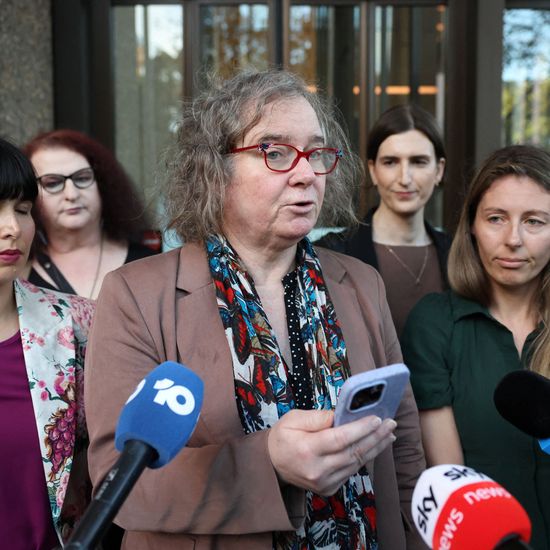
The case centered on Roxanne Tickle, a transgender woman, and her legal challenge against the removal of her account from a female-only networking platform known as Giggle for Girls.
The app had been designed by its founder, Sall Grover, as a private digital space for women.
Its purpose, according to its creators, was to provide a controlled environment for women seeking friendship, housing connections, and community support.

But that purpose became the heart of a legal conflict.
Roxanne Tickle had joined the platform and was later removed after her profile was reviewed by those managing the app.
That decision triggered a legal complaint that eventually reached Australia’s federal court system.
In the lower court, the matter had already been considered significant, with findings of indirect discrimination against the platform’s operator.
However, the appeal brought a more severe outcome.
The full federal court concluded that Tickle had been directly discriminated against.
That distinction—between indirect and direct discrimination—became the most important legal turning point of the case.
Outside the courtroom, Roxanne Tickle addressed the media.
She described the ruling as a moment of validation not just for herself, but for other transgender and gender-diverse individuals.
She said she hoped the outcome would help others feel seen and supported under the law.
Her statement quickly circulated across media outlets, intensifying public debate.
Inside legal circles, the ruling was being described as a landmark decision.
Outside legal circles, it was being interpreted through a far more emotional and political lens.
Supporters of the ruling argued that the case reinforced equal protection laws and ensured that discrimination could not be justified by platform exclusivity.
They emphasized that anti-discrimination principles must apply consistently across all services, regardless of their intended audience.
For them, the court had simply reaffirmed legal equality.
However, critics of the ruling saw the situation differently.
They argued that the purpose of the app had always been to create a space exclusively for biological women.
From that perspective, they believed the removal of Tickle was consistent with the platform’s intended design and community boundaries.
The tension between these two interpretations quickly escalated.
The case became more than a legal dispute.
It became a cultural flashpoint.
Commentators on television and radio began debating the broader implications.
Was the ruling about access and inclusion?
Or was it about redefining the limits of private community spaces?
Legal analysts pointed out that the court was not deciding social philosophy, but interpreting statutory protections under discrimination law.
Still, the public discussion quickly moved beyond legal technicalities.
The emotional intensity of the issue made it difficult for many observers to separate law from ideology.
Roxanne Tickle’s public remarks after the ruling added another layer to the story.
She spoke about the emotional toll of the legal process, describing years spent navigating legal systems and public scrutiny.
Her comments highlighted the personal dimension of the case, framing it as more than a legal victory.
For her supporters, the ruling symbolized resilience and recognition.
For critics, it raised questions about the boundaries of identity-based platforms.
Sall Grover, the founder of Giggle for Girls, also became a central figure in the aftermath.
Her platform had been built around a specific vision of women-only digital space, and the court’s decision directly challenged that model.
Legal observers noted that the case was likely not over.
An appeal to a higher court remained a possibility, and public statements suggested that further legal action could follow.
This uncertainty ensured that the debate would continue well beyond the initial judgment.
In the days following the ruling, commentary across Australia intensified.
Media panels featured legal experts, activists, and commentators from across the political spectrum.
Some framed the decision as a necessary reinforcement of equality law.
Others viewed it as a precedent that could reshape the way private platforms define their membership criteria.
The divide was not simply legal.
It was philosophical.
It touched on questions of identity, inclusion, privacy, and the definition of community in the digital age.
As the discussion spread internationally, observers noted that similar debates were emerging in other countries as well.
The intersection of gender identity and digital spaces had become a recurring legal and cultural issue.
In that sense, the Australian ruling was part of a much broader global conversation.
What made this case particularly striking was not only the legal outcome, but the way it exposed deeply held differences in public understanding.
Two sides could look at the same facts and arrive at fundamentally different conclusions.
One side saw protection from discrimination.
The other saw protection of a defined community space.
Neither perspective fully disappeared after the ruling.
Instead, both became more visible.
The federal court’s decision therefore did more than resolve a legal appeal.
It intensified an already complex social debate.
Legal experts suggested that future cases would likely revisit similar questions, particularly as digital platforms continue to grow in importance.
The concept of “women-only” or identity-based online spaces is now under increasing legal scrutiny worldwide.
At the heart of the matter lies a broader question: how should modern law balance inclusion with the autonomy of private communities?
That question remains unresolved.
And perhaps that is why this case continues to attract so much attention.
Because beyond the courtroom, beyond the legal language and technical rulings, there is a deeper issue being negotiated in real time.
How societies define belonging in an increasingly complex world.
And who gets to draw the boundaries.